The Unfair Stigma of Hearing Loss - Pt. II

The Unfair Stigma of Hearing Loss - Pt. II
 In Part 1 of this article (found here), I mentioned an elderly couple that I approached on my bike that didn't hear me. As you might have noticed, I theorized several reasons why that man might be resisting getting hearing "assistance." Since then, I started thinking more about the possible association with hearing loss and simply being elderly.
When I turned 42, I noticed my eyesight getting blurry when I would read printed material or the computer. Okay, I thought, I'm probably going to need glasses. There's a certain "resistance versus resignation" to getting older that I think we all struggle with. We can't fight Father Time though, as much as we try. Perhaps admitting to a hearing loss is also admitting to getting older, and even to one's own mortality.
So why not take every opportunity to maximize the enjoyment of every day? Every minute? Why do some people resist going to a hearing doctor (an audiologist) and explore options for hearing aids, but are perfectly fine going to an eye doctor and paying for glasses? We talked about that in the last article, but I wanted to explore the idea of the hearing loss stigma a little more, and found some interesting research.
 The Impacts Caused By The Hearing Loss Stigma
Despite how prevalent hearing loss is (around 20 percent of Americans report that they have hearing loss to some degree), the stigma still persists. Whenever people are ashamed of having a hearing loss, they might refuse to acknowledge their problem. There was another study that Southall, Gagne, and Jennings conducted where participants experience a high level of stress when attempting to conceal or deny their hearing loss. Both professionally and personally they were afraid of being labeled and put off going to see an audiologist.
Even after they visit a doctor, an individual may reject hearing aids since they are afraid of looking old, and feeling inferior or ashamed, or view hearing devices as being signs of weakness and being handicapped. Unfortunately, failing to seek treatment may cause long-term effects.
Fighting the Stigma
How can we effectively fight the hearing loss stigma? Education is the key. By educating the public (including individuals with hearing loss) about the various challenges involved with hearing loss as well as the benefits that treatment can provide, empathy can be fostered which can lead to a more positive outlook for hearing health.
Finally, if you are suffering from hearing loss, don't allow the stigma to hold you back. You might feel as if a hearing aid makes you look old, but it actually will help you in many ways in maintaining your youth. After all, young people who have excellent hearing do not continuously ask other individuals to repeat themselves constantly. They don't respond in conversations inappropriately because they are unable to hear the other part of the conversation. They don't disconnect socially because they are struggling to hear the conversation.
These days, hearing aids are very effective and can help you maintain your mental faculties, your social life, and maybe even your career. Modern hearing aids are also very inconspicuous and small, so you won't have to worry that you will stand out in a crowd. If you really want to hide the fact that you are suffering from hearing loss, then check out the discreet styles such as receiver-in-the-ear (RITE) and completely-in-the-canal (CIC) hearing aids. Also, search for a hearing aid that comes with an inconspicuous remote, to allow you to not draw attention to yourself whenever you are wanting to press the program button or change the volume. There are some devices that connect to a smartphone, which makes them technologically savvy and very convenient. Whenever you need to use your hearing aid's control center, it will just look like you are using your cell phone.
Get a dang hearing test already!
If you have been procrastinating having a hearing test, you are not alone. Most people wait, on average, almost seven years from the time when they first notice there is a change in their hearing before they actually seek out help. Seven years worth of strained relationships at work and at home, missing out on so many of the sounds all around you, and risking health problems that are associated with hearing loss.
Keep in mind that it is critically important to treat hearing loss for your future and current health. Rather than hiding your struggles, help to reverse the hearing loss stigma by using hearing devices and helping to encourage other people that you know to go see an audiologist.
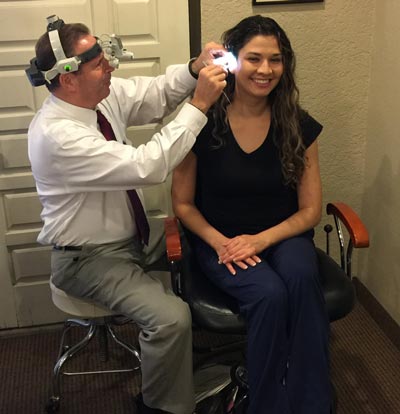
I'm so glad that I listened to my wife and scheduled a hearing test with Dr. Allen and Amy Rohe. Not only were they knowledgeable about their craft, but hey were just genuinely kind people, so the hearing test and conversation about options was very casual and friendly. I was able to try a pair of hearing aids for a week or so, and Dr. Rohe actually let me try a few other pairs until I got the set that I loved. Who does that? Having those options and such an enjoyable interaction is plenty to highly recommend Tinnitus & Hearing Center of Arizona.
If it's any consolation, my wife is happier that she doesn't have to repeat herself all the time, and I'm happier knowing that I can hear most any conversation now. And that, to me, is priceless.
The information provided in this article is not meant to be medical advice and is for educational purposes only. If you would like to learn more about this and other hearing-related topics, feel free to contact Tinnitus & Hearing Center of Arizona by clicking here or by calling 480-831-6159.